Critère de Kelly et roulette
Le critère de Kelly indique au joueur qui a un avantage combien miser. Pour la roulette, il donne une réponse nette : rien.

Mise de Kelly = avantage / cote. Avec un avantage négatif, la formule donne une fraction négative, ce qui signifie ne pas miser. Le critère reste utile pour comprendre pourquoi les joueurs de biais dimensionnaient leurs mises comme ils le faisaient, et pourquoi tous les autres doivent les dimensionner d’après un budget.
Le critère
John Kelly (1956) asked how a gambler with a known edge should size bets to maximize long-run growth of the bankrollargentCapital de jeuLa somme totale mise de côté pour jouer. Gérer son capital de jeu, c’est décider quelle part en risquer par pari et par session.Lire en entier →. The answer, for a bet paying b to 1 with win probabilitymathsProbabilitéMesure de la possibilité d’une issue, de 0 à 1 ou de 0% à 100%. Un numéro : 1/37 = 2,70%.Lire en entier → p and loss probability q = 1 − p, is to stake the fraction f* = (bp − q) / b of the bankroll. Positive f* means bet that fraction; zero or negative means do not bet. Kelly worked at Bell Labs, and his paper, “A new interpretation of information rate”, set the problem in Claude Shannon’s theory of information: a gambler who gets tips over a noisy line, at fair odds, can grow the bankroll at best at the rate the line carries information. This is a growth objective under a probability model, not a promise to finish ahead after a particular number of bets. A spending limit, finite deadline or payoutargentPaiementCe que rapporte un pari gagnant, exprimé sous la forme « X contre 1 », en plus de la mise rendue.Lire en entier → cap changes the decision problem.
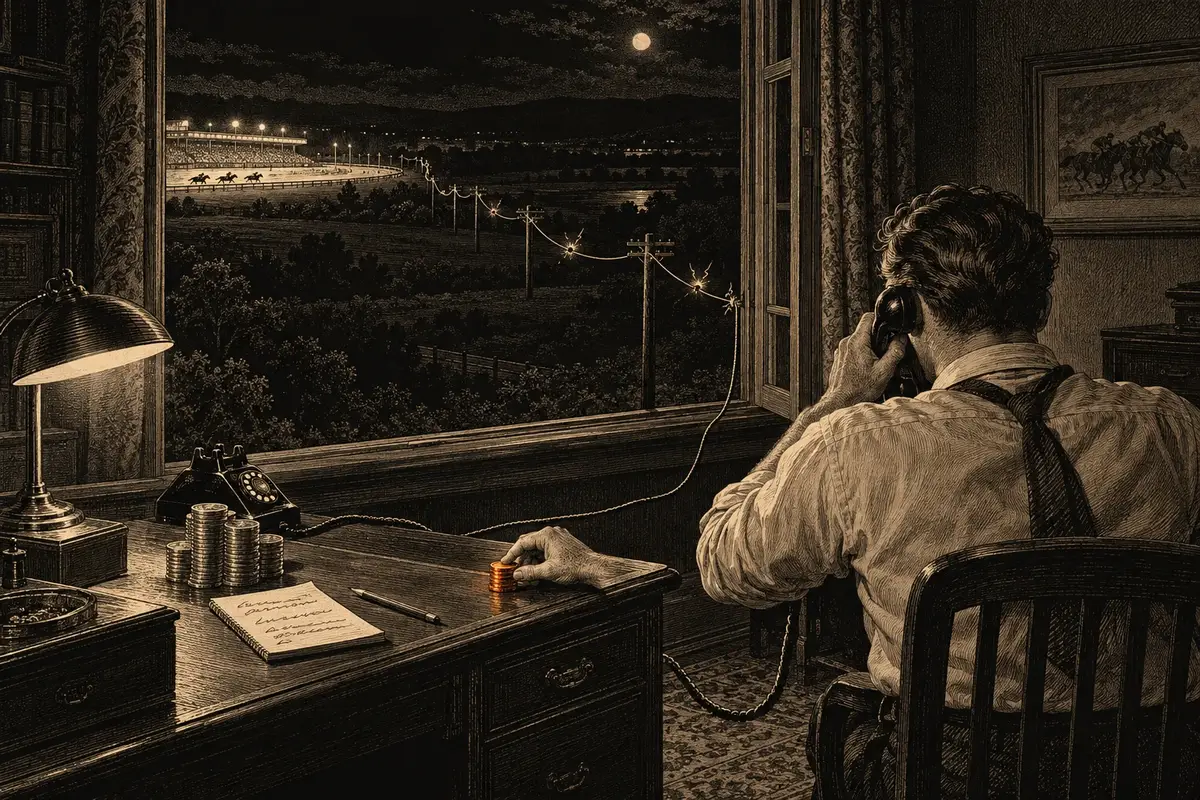
La mise de Kelly à la roulette
For redpariRedNom anglais du rouge, courant sur les tables en ligne. Chance simple sur les 18 numéros rouges.Lire en entier →: b = 1, p = 18/37, q = 19/37; f* = (18/37 − 19/37)/1 = −1/37. For a straight uppariStraight upNom anglais du plein, courant sur les tables en ligne. Un seul numéro, paie 35:1.Lire en entier →: b = 35, p = 1/37, q = 36/37; f* = (35/37 − 36/37)/35 = −1/1295. Every standard bet gives a negative Kelly fraction, because every bet has a negative edge, and the growth-optimal stake is zero. Kelly betting on roulette is a formal way of saying what the house-edge page says: no positive stake maximizes expected logarithmic growth when the bet has negative expectation. A particular session can still end in profit. La partagerègleLe partageRègle française : quand le zéro sort, la moitié de la mise d’une chance simple est rendue. Elle divise par deux l’avantage de la maison sur ces paris, à 1,35%.Lire en entier → needs a separate three-outcome calculation: a win, a full loss or a half-loss on zerocylindreZéroL’unique case verte, qu’aucune chance simple, douzaine ou colonne ne couvre; la source de l’avantage de la maison. Aussi : zéro simple, 0.Lire en entier →. Its expected log growth also falls as the stake increases from zero.
| pari | b | p | f* = (bp − q)/b | signification |
|---|---|---|---|---|
| rouge, européenne | 1 | 18/37 | −0,027 | ne pas miser |
| rouge, partage | trois issues | 18/37 gagnant; 1/37 demi-perte | la formule binaire ne s’applique pas | mise optimale pour la croissance : 0% |
| plein | 35 | 1/37 | −0,00077 | ne pas miser |
| plein sur une case à 1/30 (biaisée) | 35 | 1/30 | +0,0057 | miser 0,57% du capital de jeu |
| plein sur une case à 1/25 | 35 | 1/25 | +0,0126 | miser 1,26% du capital de jeu |
Là où Kelly s’appliquait
Suppose a pocketmatérielCaseL’un des 37 compartiments numérotés du rotor. Aussi : alvéole, logement.Lire en entier → really has a stable, known probability of 1 in 30 and pays 35 to 1. The Kelly fraction is 0.57%: about $57 from a $10,000 bankroll. Under independent spinsmathsCoups indépendantsChaque coup a les mêmes probabilités, quel que soit l’historique. C’est la base de tous les calculs de ce site.Lire en entier → and exact fractional staking, the geometric growth factor over 1,000 spins is about 1.7. Expected bankroll grows faster because rare large wins pull up the average. These are model calculations, not evidence that any named historical player used Kelly or achieved this result.
Typique et moyen
The gap between the typical bankroll and the average one is wide. Take a pocket that hits 1 time in 25, a hypothetical edge of 44% per unitargentUnitéLa mise de base dans laquelle un système ou un joueur compte. Les progressions sont décrites en unités afin de s’appliquer à n’importe quelle table.Lire en entier → staked. Kelly stakes 1.26% of the bankroll on it. After 1,000 spins the typical bankroll has grown about 11.5 times, while the average, pulled up by a few very lucky runs, has grown about 249 times. Betting more than Kelly raises the average and lowers the typical result: at twice the Kelly stake the typical bankroll only doubles, and by two and a half times the Kelly stake it shrinks, although every bet still carries a 44% edge. In this example, half-Kelly retains about 78% of the expected log growth. This fraction depends on the probabilities and payout.
| mise, part de Kelly | mise, % du capital | capital typique après 1 000 coups |
|---|---|---|
| ½ | 0,63% | × 6,7 |
| 1 | 1,26% | × 11,5 |
| 1½ | 1,89% | × 7,4 |
| 2 | 2,51% | × 2,2 |
| 2½ | 3,14% | × 0,38 |
| 3 | 3,77% | × 0,04 |
Quand l’avantage est une supposition
Kelly uses the true probabilities, but a player usually has only estimates. Selecting the busiest pocket from a past record creates a selection problem: even a fair wheel has a busiest pocket. Its observed rate can overstate its future probability. Choosing the stake from that same record compounds the error. An independent follow-up sample helps test a proposed bias (see How to Detect Roulette Wheel Bias). Reducing the calculated fraction reduces exposure, but cannot turn a false edge into a real one.
Ceux qui ont un avantage
Haghani and Dewey (2016) studied 61 participants given $25 and 30 minutes to bet on a simulated coin with a disclosed 60% chance of heads. The payout cap was $250; its value was revealed when a proposed winning bet would reach it. Their reported 21% success category included balances of at least $200, while the 28% “bust” category meant less than $2, not necessarily zero. Eighteen participants bet their entire balance on one flip. The uncapped Kelly fraction is 20%, but the cap and deadline change the optimization problem. The experiment illustrates how stake choices matter even with a known advantage; it does not establish one best strategy for every objective.
Que faire à la place
Sans avantage, le dimensionnement est une question de budget, non de croissance : mise = ce que vous êtes prêt à dépenser par coup, déduit du budget horaire et de la cadence de la table (page sur la gestion du capital de jeu). L’apport de Kelly au joueur ordinaire est la netteté de sa réponse : zéro. Tout ce que vous misez au-dessus de zéro est le prix du jeu, choisi par vous, optimisé par aucune formule.
Une remarque sur le Kelly fractionnaire et la « gestion du capital de jeu »
Betting a fixed percentage of the current bankroll is proportional staking: the stake rises after wins and falls after losses. Flat bettingstratégieMise constanteMiser le même montant à chaque coup. La référence à laquelle toute progression est comparée.Lire en entier → instead keeps the cash stake fixed. Neither creates an edge on ordinary roulette. With infinitely divisible stakes and a fraction below 100%, proportional staking never reaches exactly zero in finitely many losses, but the balance can become arbitrarily small. Real table minimums can prevent further play much sooner. The growth-optimal fraction remains zero.
Formule
Questions
Only when the actual probabilities, payouts and conditions give a credible positive advantage. Standard bets on an unbiased wheel have no such advantage.
Using half the calculated fraction reduces exposure to errors in the estimated edge. The familiar three-quarters-growth rule is an approximation for small advantages, not a universal identity. It does not protect against an edge that does not exist.
Non. Kelly optimise la croissance quand on a un avantage. La gestion du capital de jeu contrôle les dépenses quand on n’en a pas.
Mathématiques pour le plaisir
Essayez d’abord par vous-même. Chaque solution est repliée : ouvrez-la quand vous êtes prêt.
Suppose a hypothetical bet on one number has a known 44% edge under standard payoutsargentPaiementCe que rapporte un pari gagnant, exprimé sous la forme « X contre 1 », en plus de la mise rendue.Lire en entier → and independent spinsmathsCoups indépendantsChaque coup a les mêmes probabilités, quel que soit l’historique. C’est la base de tous les calculs de ce site.Lire en entier →. Kelly gives a 1.26% bankrollargentCapital de jeuLa somme totale mise de côté pour jouer. Gérer son capital de jeu, c’est décider quelle part en risquer par pari et par session.Lire en entier → fraction. What if the same 44% edge came on one bet spread over five neighboring numbers?
Afficher la solution
Réponse Kelly préconise alors 7,1% du capital, et le capital croît presque six fois plus vite : il est multiplié par environ 1,25 million en 1 000 paris, contre environ 11,5.
A straight uppariStraight upNom anglais du plein, courant sur les tables en ligne. Un seul numéro, paie 35:1.Lire en entier → with a 44% edge wins with chance 0.04, since 36 × 0.04 = 1.44. Kelly’s stake is the edge divided by the odds: 0.44/35 = 1.26%. The typical growth per bet is 0.04 × ln(1 + 35 × 0.0126) + 0.96 × ln(1 − 0.0126) ≈ 0.00244, so 1,000 bets multiply the bankroll by about e^2.44 ≈ 11.5.
Spread one stake over five numbers and the bet wins with chance 0.20 and pays 36/5 for 1, that is 6.2 to 1: still a 44% edge, since 0.2 × 7.2 = 1.44. Kelly’s stake becomes 0.44/6.2 = 7.10%, and the growth per bet 0.01404, about 5.75 times as much. Over 1,000 bets that is e^14.04, about 1.25 million.
The edge is the same; the swings are smaller. A bet that wins one time in five has a larger growth-optimal fraction in this model, although losses can still reduce the bankroll severely. This comparison assumes the same known edge for both bets; actual predictions need independent evidence.
Assume two numbers are adjacent on the betting layoutmatérielTapisLa grille de mise imprimée sur la table. Aussi : table, feutre, drap.Lire en entier → and each has a stable, known probabilitymathsProbabilitéMesure de la possibilité d’une issue, de 0 à 1 ou de 0% à 100%. Un numéro : 1/37 = 2,70%.Lire en entier → of 1 in 25 on independent spins. Compare a splitpariSplitNom anglais du cheval, courant sur les tables en ligne. Deux numéros voisins, paie 17:1.Lire en entier → between them at 17 to 1 with equal straight-up stakes on the two numbers. How much does Kelly say, and how fast does the bankroll grow compared with one such pocketmatérielCaseL’un des 37 compartiments numérotés du rotor. Aussi : alvéole, logement.Lire en entier →?
Afficher la solution
Réponse Cela ne change rien : 2,59% du capital sur le cheval, ou 1,29% sur chaque numéro. Le capital typique est multiplié par environ 155 en 1 000 coups, contre 11,5 avec une seule case.
The split wins with probability 2/25 = 0.08 and pays 17 to 1, so it returns 18 × 0.08 = 1.44 per unitargentUnitéLa mise de base dans laquelle un système ou un joueur compte. Les progressions sont décrites en unités afin de s’appliquer à n’importe quelle table.Lire en entier → staked: an edge of 44%, the same as one biased pocket. Kelly’s stake is the edge divided by the odds: 0.44/17 = 2.59%.
Two straight-up bets of 1.29% each give exactly the same results. When either number comes up, one chipargentJetonUne pièce représentant un montant fixe, posée sur le tapis pour faire un pari. Aussi, en anglais : cheque.Lire en entier → wins 35 to 1 and the other is lost, a net of 34 × 1.29% = 44% of the bankroll, as the split pays; when neither does, both are lost.
The growth per spin is 0.00505, against 0.00244 for one pocket, so over 1,000 spins the typical bankroll grows e^5.046 ≈ 155 times rather than e^2.44 ≈ 11.5 times. The geometric growth factor is larger because the combined bet wins more often at the same 44% edge. It is a model result, not a guaranteed bankroll.
Intermède comique
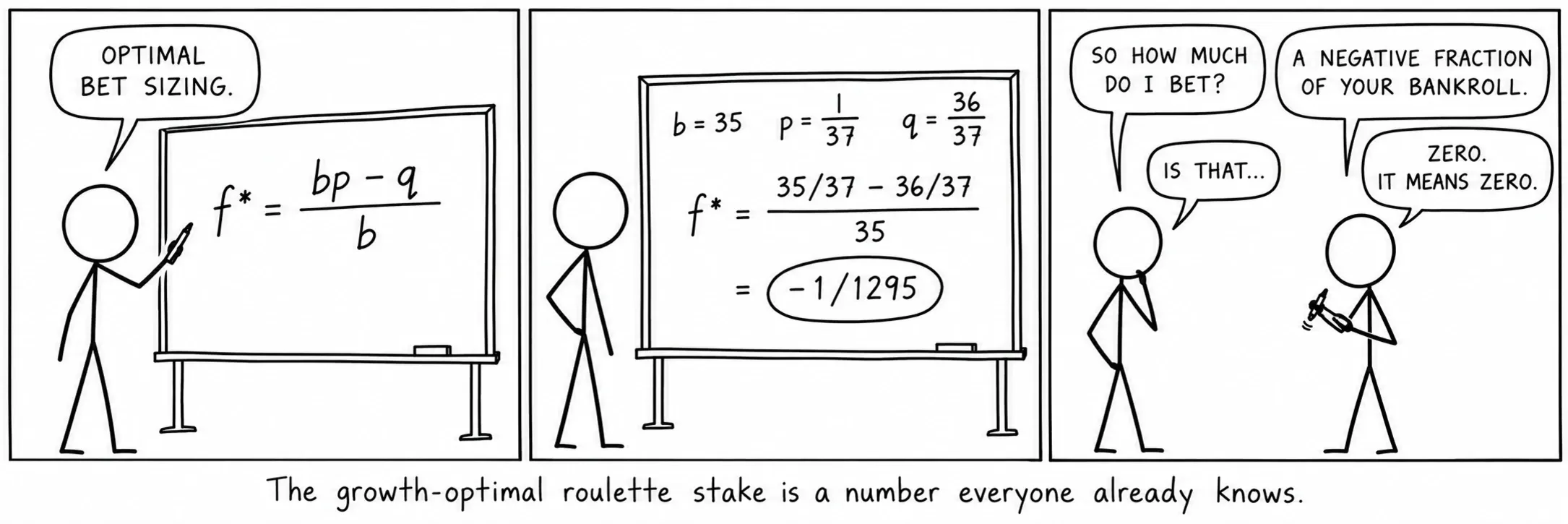
La mise de roulette qui optimise la croissance est un nombre que tout le monde connaît déjà.
Sources
- Kelly, J. L. “A new interpretation of information rate.”
- Breiman, L. “Optimal gambling systems for favorable games.”
- Thorp, E. O. “Optimal gambling systems for favorable games.”
- Thorp, E. O. The Mathematics of Gambling.
- Epstein, R. A. The Theory of Gambling and Statistical Logic, 2nd ed.
- Taylor, D. G. Games, Gambling, and Probability: An Introduction to Mathematics, 2nd ed.
- Ethier, S. N. The Doctrine of Chances: Probabilistic Aspects of Gambling.
- Haghani, V. & Dewey, R. “Rational decision-making under uncertainty: observed betting patterns on a biased coin.”