Pourquoi la roulette est-elle si addictive?
Roulette can become difficult to stop. Understanding the odds is useful, but it is not protection against gambling harm.
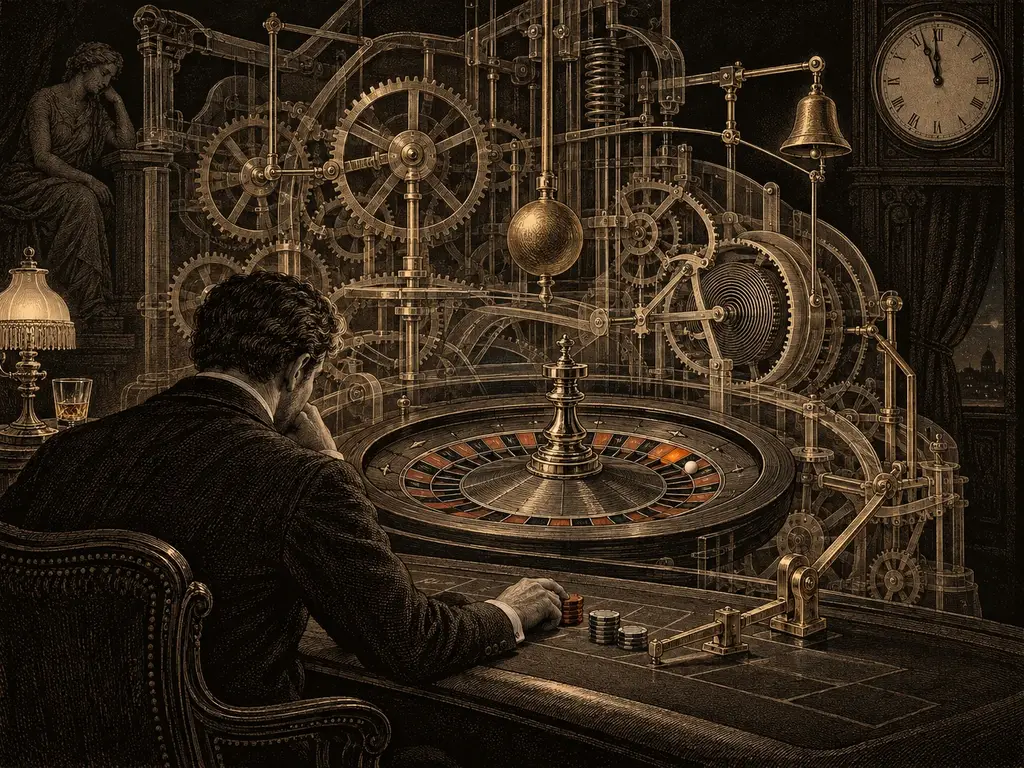
Uncertain rewards, repeated opportunities to bet and the feeling of being close to a win can make gambling compelling. Research helps explain some of these experiences, but individual risk has many influences. You do not need to wait for severe problems before seeking support.
Unpredictable rewards
In an independent uniform single-zerocylindreZéroL’unique case verte, qu’aucune chance simple, douzaine ou colonne ne couvre; la source de l’avantage de la maison. Aussi : zéro simple, 0.Lire en entier → model, a particular number has a 1/37 chance of winning each spin. RedpariRedNom anglais du rouge, courant sur les tables en ligne. Chance simple sur les 18 numéros rouges.Lire en entier → has an 18/37 chance. Wins can be separated by short or long gaps; neither probabilitymathsProbabilitéMesure de la possibilité d’une issue, de 0 à 1 ou de 0% à 100%. Un numéro : 1/37 = 2,70%.Lire en entier → sets a timetable.
An unpredictable win can feel compelling, but this arithmetic does not measure how addictive a game is. Claims that roulette produces the strongest possible persistence in every person or species go beyond the evidence presented here.
Repeated opportunities to bet
At the same stake and house edgemathsAvantage de la maisonLa part de chaque mise que le casino garde en moyenne : 2,70% à la roulette européenne.Lire en entier →, more bets mean more expected lossmathsPerte attendueL’espérance mathématique multipliée par le montant total misé; le montant perdu en moyenne sur une session ou une période.Lire en entier →. For example, 100 standard single-zero bets of $1 have an expected total loss of about $2.70; 200 have an expected loss of about $5.41. Actual results vary.
Round speeds and pauses differ between games. There is no single roulette round length, and a smaller stake does not slow the game itself. Counting bets is useful for understanding exposure, but it is not a clinical measure of reinforcement or a safe-play threshold.
Near misses: what the study found
Clark and colleagues’ 2009 study used a slot-like laboratory task. In a behavioral experiment with 40 healthy volunteers, near misses increased reported desire to continue on trials where participants chose the play icon; the effect did not apply in the same way when the computer chose. A separate group of 15 underwent brain imaging.
The task offered wins or no win, rather than a chance to lose participants’ money. It was not a roulette trial or a study proving that near misses cause gambling disorder. It offers evidence about a particular response under particular conditions. On roulette, landing beside your selected pocketmatérielCaseL’un des 37 compartiments numérotés du rotor. Aussi : alvéole, logement.Lire en entier → is still a losing straight-up bet.
Choice and control
Choosing a number, a stake or a stopping point is a real decision. Those choices affect the bet’s coverage, the money at risk and how long play continues. They do not let a player choose the result of an independent uniform spin.
The same laboratory study found that personal choice affected participants’ ratings of their chances. That is a finding about perceived control, not evidence that number selection altered the game’s probabilities. This page does not rank roulette against other games using invented psychological scores.
Practical support
If gambling is becoming hard to control, support can include self-exclusion, blocking access to gambling and speaking to a professional or someone you trust. A budget or an understanding of probability should not be treated as a substitute for help.
The NHS page linked below explains options in England, including self-referral to specialist gambling treatment clinics. Elsewhere, use the support services available in your area. The Responsible Gambling page provides starting points.
When to seek help
Warning signs can include spending money needed for essentials, chasing losses, borrowing to gamble, or harm to relationships, health or finances. WHO emphasizes that harm can occur below the threshold for a gambling-disorder diagnosis.
You do not have to prove that your experience is “bad enough”. If you are worried about your gambling or someone else’s, asking a healthcare professional or gambling-support service is a reasonable next step. These signs are not a diagnosis, and difficulty stopping is not a personal failure.
Questions
The studies cited here do not establish a universal ranking. Product features, access and personal circumstances all matter. A comparison should not distract from harm you are experiencing now.
It can help you recognize misleading claims, but it does not guarantee control over gambling or prevent harm.
Seek support rather than relying on a stronger betting rule. The linked NHS guidance describes treatment and practical options; local services can advise on the help available where you live.
Intermède comique
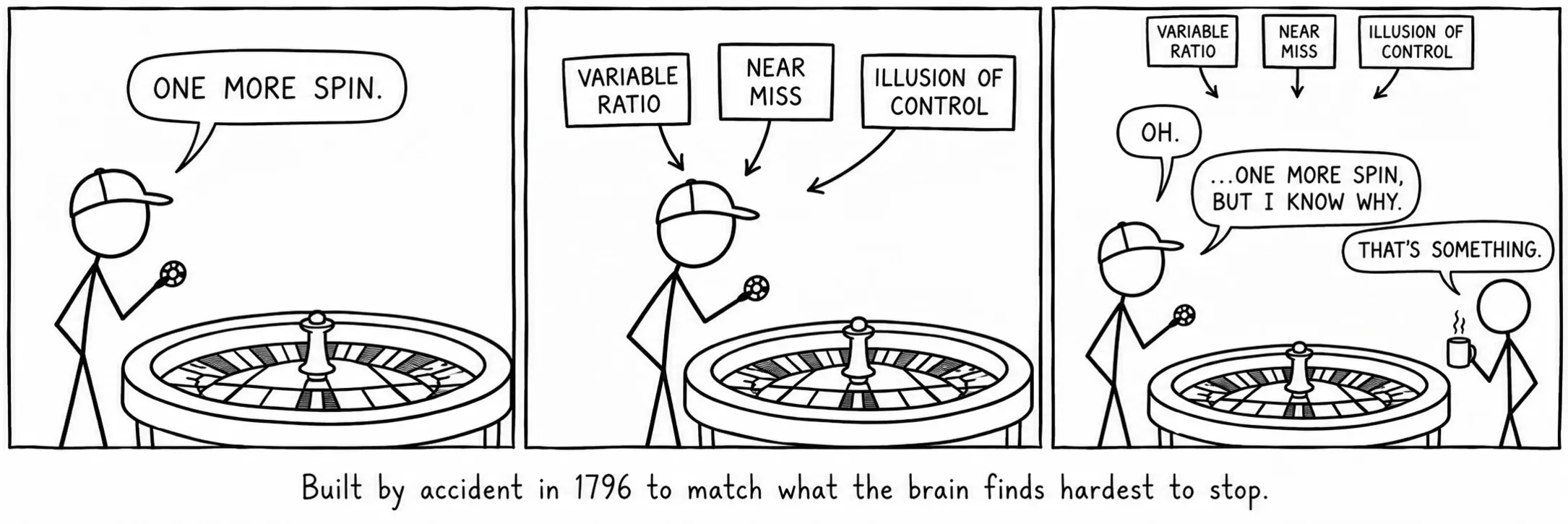
Knowing the odds is not a substitute for support.
Sources
- Clark et al., Gambling Near-Misses Enhance Motivation to Gamble and Recruit Win-Related Brain Circuitry, 2009
- WHO, Gambling fact sheet, 2 December 2024
- NHS, Help for problems with gambling — checked 15 November 2026